Golden Bay / Mohua is unusually dependent on the telecommunications infrastructure that crosses Tākaka Hill. The route serving the district has been damaged three times since 2022, and during the July 2025 outage public reporting recorded loss of mobile and internet services and affected 111 access.
STRIM — Strengthening Telecommunications Resilience in Mohua — is a small volunteer group working to improve that resilience.
My role has combined communications strategy, research, evidence development and increasingly sophisticated use of AI tools to help a small volunteer team work across a complex systems problem.
The project has required us to understand much more than telecommunications technology alone. Infrastructure resilience crosses network architecture, electricity supply, emergency communications, regulation, commercial responsibility and the lived experience of the community when systems fail.
Turning an outage into evidence
One of the most useful opportunities arose ahead of a planned electricity outage on 19 July 2026. We realised the outage provided a rare opportunity to observe what happened to telecommunications when household power disappeared across a large part of Golden Bay at the same time.
Using local community channels, STRIM invited residents to report what they experienced while the event was still fresh.
The study was deliberately treated as community evidence rather than a controlled technical experiment. It did not establish whether people could call 111, and weaker contextual observations were kept separate rather than used to make the findings appear stronger than they were.
AI tools helped organise and analyse the free-text reports, identify recurring patterns and support the development of structured data, visualisations and an interactive public evidence map. Human review remained essential throughout.
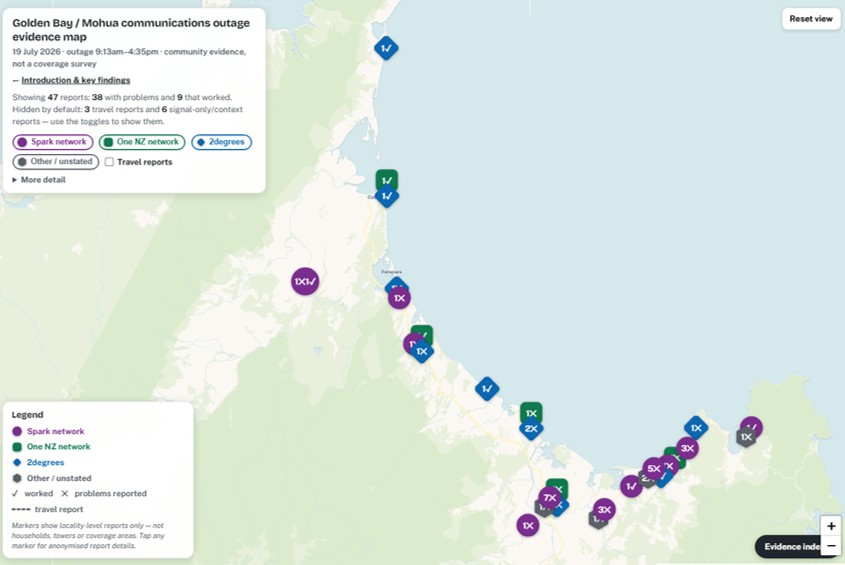
The result was something a small community group could use: not simply stories about an outage, but a structured evidence base that could be compared with information from operators, regulators and other infrastructure organisations.
The project has since expanded into analysis of resilience principles, published industry material, emergency-communications research and submissions from organisations across New Zealand’s infrastructure sector.
From evidence to the regulatory conversation
In August 2026, STRIM filed a submission with the Commerce Commission as part of its consultation on infrastructure resilience.
For me, STRIM has also become a practical exploration of what human–AI collaboration looks like when the subject is consequential and the evidence matters.
AI can dramatically increase the amount of research, comparison and analysis one person can undertake. But the more capable those tools become, the more important human judgement becomes too: deciding which questions matter, distinguishing evidence from assumption, understanding limitations and knowing what should not be claimed.
The value was not producing more material. It was turning lived experience into evidence that could survive scrutiny.
That combination has allowed a very small volunteer group to engage with a complicated infrastructure problem at a depth that would otherwise have been difficult to sustain.
The telecommunications issue itself remains unresolved.
But the community is now contributing evidence to the discussion rather than simply experiencing the consequences of infrastructure failure.